
At the THI, a team led by Professor Gordon Elger is researching new technologies for so-called e-textiles – that is, fabrics and garments with integrated electronics. The research centres on the question: How can electrical conductors and electronic components be integrated into clothing without compromising comfort or the reliability of the electronics? The THI’s approach involves special particle-free copper inks, which PhD student Nihesh Mohan is researching and further developing for practical application. These inks allow electronic circuit tracks to be printed directly onto fabrics and other flexible materials. Using a very fine laser beam, the salt-based inks are converted into metallic copper tracks. These perform functions similar to the conductor tracks on a conventional circuit board and can, for example, transmit data or energy. The particular advantage is that, whilst many electronic materials require high temperatures, the conductive copper structures are formed here at around 130 degrees Celsius. This is made possible by the ink’s special chemical composition. As a result, the process is also suitable for sensitive textiles and bio-based materials that would not tolerate higher temperatures. In the future, sensors, power lines, or other electronic functions can thus be integrated more easily directly into fabrics. This opens up new possibilities for smart textiles – from sports and health applications to intelligent workwear. The research forms part of the European research project ‘SoftIE’. Within this project, the partners are addressing a question that could prove crucial for the future of smart textiles: how can electronic components be integrated more easily into clothing whilst also being used more sustainably? Today, many manufacturers rely on their own technical solutions, which are often incompatible with one another. The researchers are therefore working on a common standard for e-textiles – comparable to the USB port, which has significantly simplified the use of electronic devices. This could make it easier to connect, replace, or reuse electronic components in the future. Alongside functionality, sustainability also plays an important role. The materials and connection solutions developed in the project are to be designed in such a way that electronic components can be more easily removed, reused, or recycled at the end of their service life. In this way, the researchers aim to help keep valuable raw materials in circulation for longer. “Many applications of smart textiles have already been technically developed and are available on the market,” says Professor Gordon Elger. “The focus now is on implementing them in a reliable, comfortable, and sustainable way. At THI, we are developing innovative materials and processes for this purpose.” |
When clothes think for themselves: Researchers at Technischen Hochschule Ingolstadt (THI) are working on smart wearable electronics
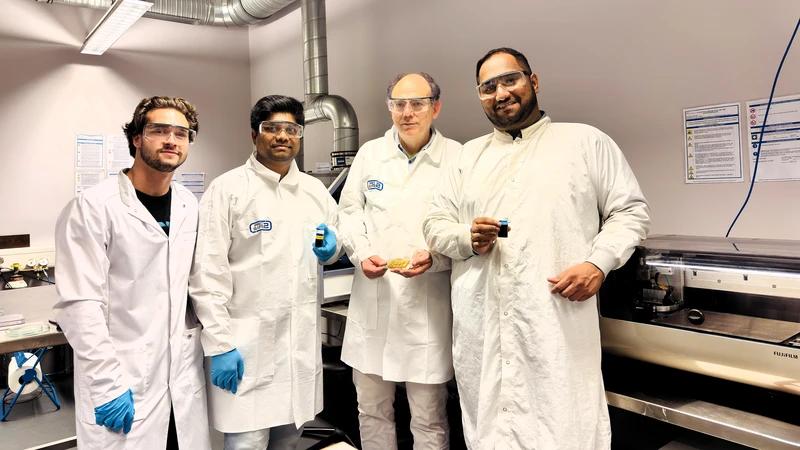
As part of the THI project “SOFTIE”, Gabriele Rigato, Gokulnath Vellaisamy, Professor Gordon Elger and Nihesh Mohan (left to right) are helping to shape the future of smart textiles (Photo: THI).

![[Translate to English:] Logo Akkreditierungsrat: Systemakkreditiert](/fileadmin/_processed_/2/8/csm_AR-Siegel_Systemakkreditierung_bc4ea3377d.webp)