
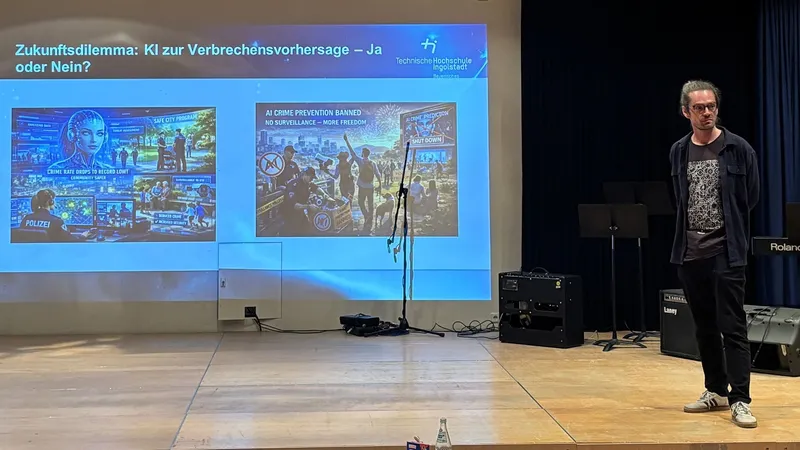
In his one-hour keynote speech, the futurologist introduced the young people to the ways of thinking of cultural and social science futurology. Instead of providing concrete forecasts, the focus was on a critical view: How do images of the future come about? What fears, hopes and expectations characterise them - both in the past and today? Using historical examples, Schönhofer showed that uncertainty, enthusiasm for progress and technological fears are not phenomena of the present. Rather, they are constant companions of human societies - formulated differently in every epoch, but always present. The active involvement of the pupils was particularly effective. In short reflection and discussion rounds, they were able to contribute their own ideas about the future, scrutinise social trends and compare different perspectives. This made it possible to experience the future not as a predetermined fate, but as a realm of possibilities that can be shaped. The lecture pursued the central aim of the Science Week: to promote scientific thinking beyond the subject lessons and to bring current social issues into the discussion. At the same time, the pupils were encouraged to critically scrutinise their ideas of progress, change and responsibility. The high level of interest showed that questions about the future are more than just theoretical for young people - they are lively, relevant and urgent. Particularly against the backdrop of global challenges such as climate change, technological transformation and social upheaval, such discussions are not only useful - they are necessary. |
Was the future better in the past? - Young people discuss future scenarios
![[Translate to English:] Logo Akkreditierungsrat: Systemakkreditiert](/fileadmin/_processed_/2/8/csm_AR-Siegel_Systemakkreditierung_bc4ea3377d.webp)