

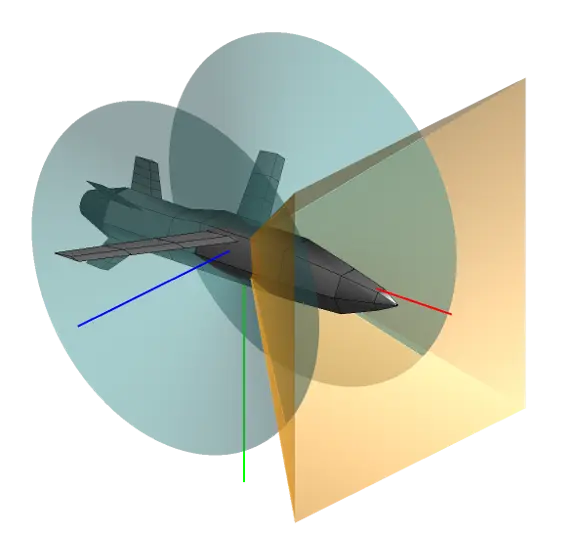
- Focus on fixed-wing (bank-2-turn) dynamics.
- Forward-looking primary sensor (EO/IR, LRF, RDR,…) with a rectangular field of view.
- One directional antenna per side with a cone-shaped characteristic (main lobe).
- Antennas serve as communication device and for mutual localization.
- A swarm can be a mix of differently equipped agents/UAVs.
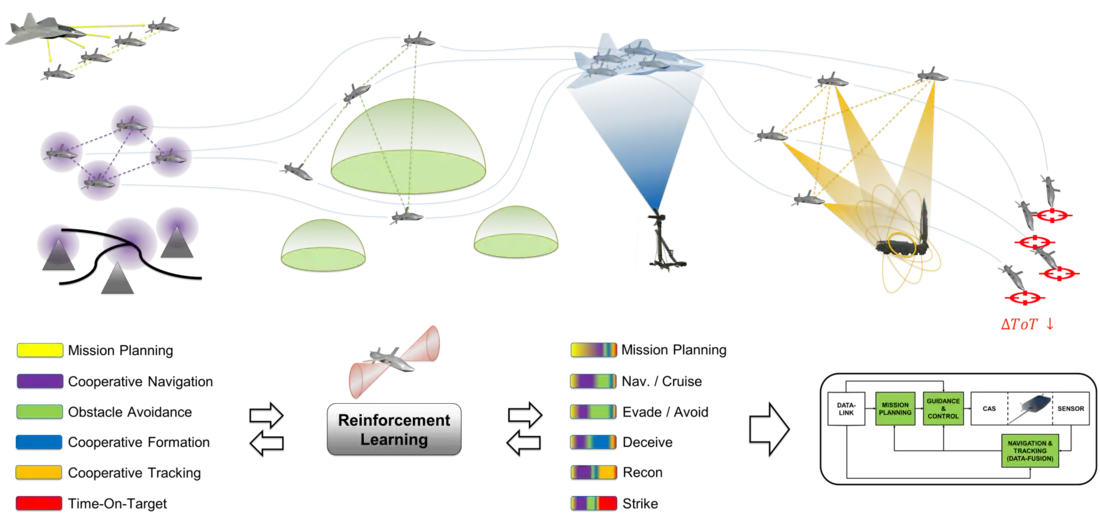
The primary reason to deploy a swarm of UAVs instead of a single entity is merely just to ‘cover more ground‘ and ensure robustness by sheer numbers, but to gain (collective) capabilities that are, if done correctly, more than just the sum of its parts.
Hence, in any swarm of UAVs, every single entity shall contribute to the collective mission that the group is tasked to fulfil. Since a mission is usually divided into several phases, the importance of different subtasks (which are necessary for the overall mission goal) changes over the course of flight.
Additionally, a swarm configuration may be either homogeneous or heterogeneous regarding the sensor-, effector- and communication-capabilities of each airframe.
Since the quality of the sensor fusion is greatly depending on relative geometry and physical systems are subject to various (geometric) constraints, the optimal spatial shape, that is the formation of the swarm, is of immense interest to guarantee mission success.
UAV-Model (Agent)
Challenges
A network of agents (nodes) forms a graph G with n agents and edges E for each valid line-of-sight (LoS) connection:

The network forms a multi-agent system, in which each agent is modeled as a nonlinear system that responds to control:
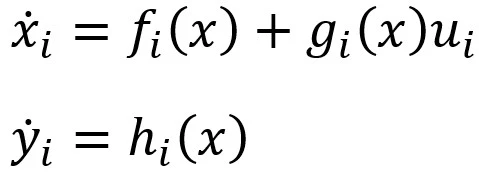
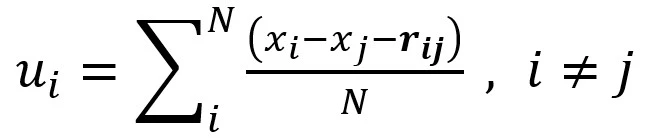
The vector rij describes the spatial offset between agents i and j.
This vector must be determined for the entire swarm in such a way that the objective function (i.e., the reward) is maximized:

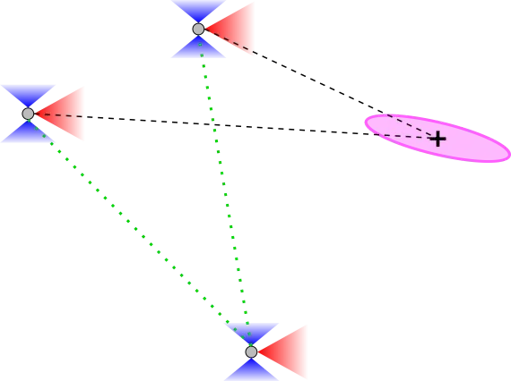
→ Two actors are pursuing a goal but have no direct connection to one another. A third actor acts as a mediator but does not pursue any goal.
Singular Optimizations
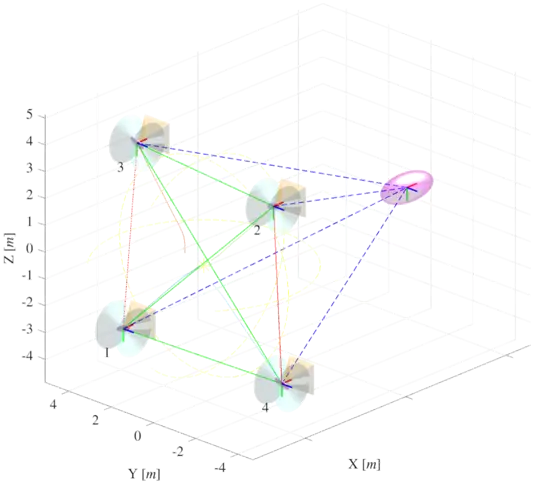
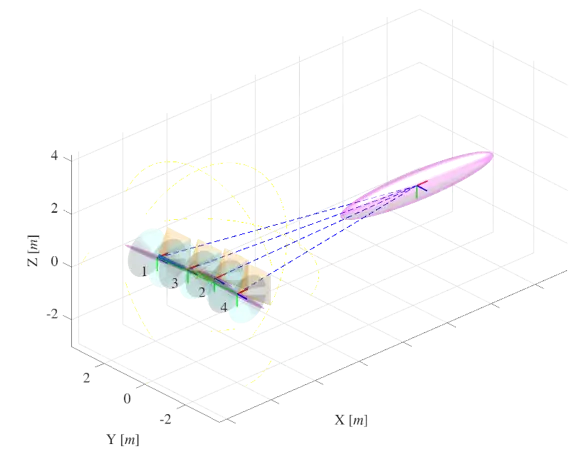
Cooperative Localization:
- Symmetry centered on the target. (here: pyramid)
- Diversity of solutions determined by the sensor's FoR

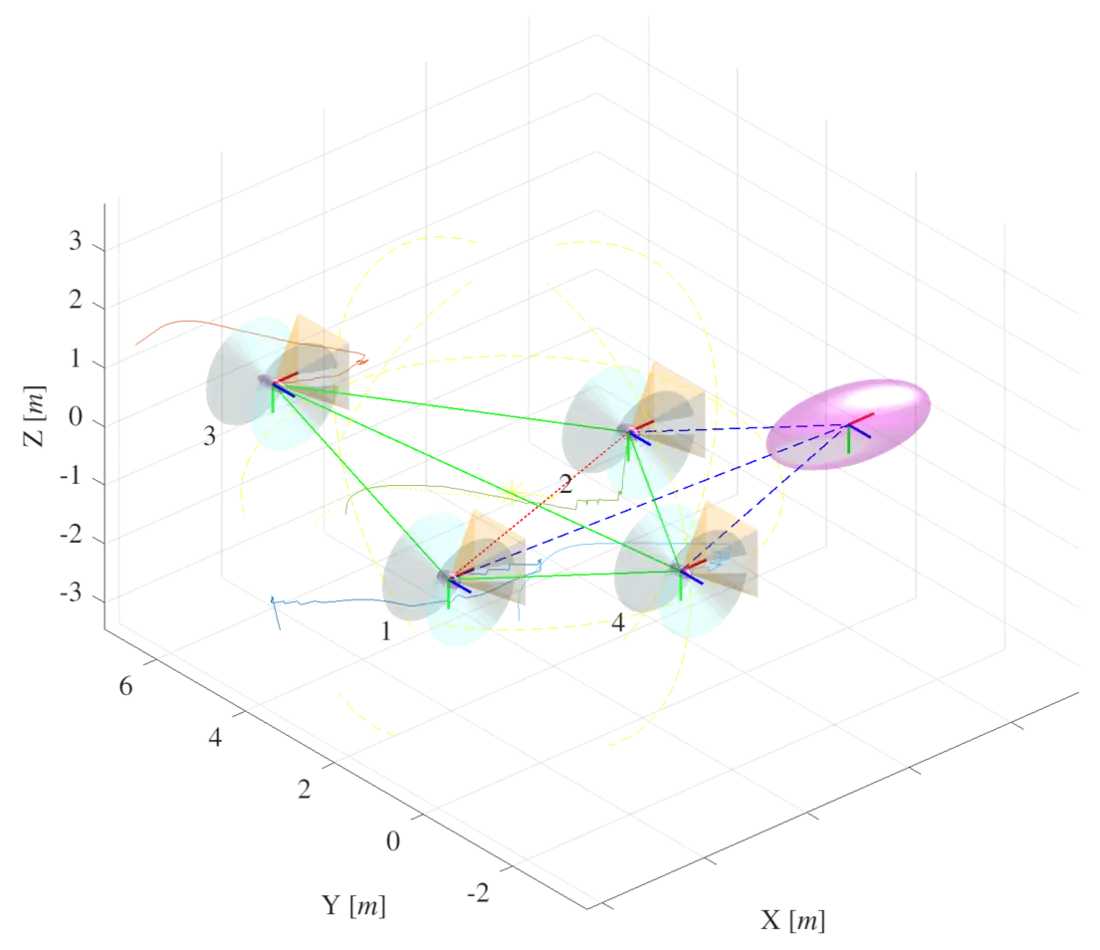
Cooperative Navigation:
- Symmetry about the geometric center (center of mass) of the formation.
- All angles and distances are balanced. (Here: tetrahedron)
THI contact person

Head of TTZ Unmanned Aerial Systems
Prof. Dr. techn. Gerhard Elsbacher
Phone: +49 841 9348-4412
Room: K309
E-Mail: Gerhard.Elsbacher@thi.de
Prof. Dr. techn. Gerhard Elsbacher
Phone: +49 841 9348-4412
Room: K309
E-Mail: Gerhard.Elsbacher@thi.de


Technology Field Manager Cooperative UAV Systems
Dr. techn. Babak Salamat
Phone: +49 841 9348-1116
Room: G001
E-Mail: Babak.Salamat@thi.de
Dr. techn. Babak Salamat
Phone: +49 841 9348-1116
Room: G001
E-Mail: Babak.Salamat@thi.de
![[Translate to English:] Logo Akkreditierungsrat: Systemakkreditiert](/fileadmin/_processed_/2/8/csm_AR-Siegel_Systemakkreditierung_bc4ea3377d.webp)