

Impuls Project 10: Localization and control in combined indoor and outdoor scenarios (KASINO)
The increasing level of automation in modern vehicles requires precise and reliable vehicle localisation in a variety of environments. While satellite-based systems are used outdoors, alternative solutions are needed indoors, such as in tunnels or car parks. Seamless positioning is crucial, particularly in transition areas.
In the first sub-project, requirements for indoor and outdoor positioning systems were defined. The combination of an INS system (iNAT M300) with an ultra-wideband-based indoor system (VIPS) proved to be a suitable solution. Following integration and initial preliminary tests within THI’s existing infrastructure, road tests were carried out at the project partner AVL, supplemented by LiDAR and camera-based localisation methods from THI, as well as a reference system from iMAR for accuracy assessment.
In addition, the project partner iMAR GmbH provided a further reference system to evaluate the systems’ accuracy during transitions between indoor and outdoor areas. The LiDAR-based method demonstrated the highest accuracy, whilst the GNSS/IMU/VIPS combination still exhibited limitations in transition scenarios.
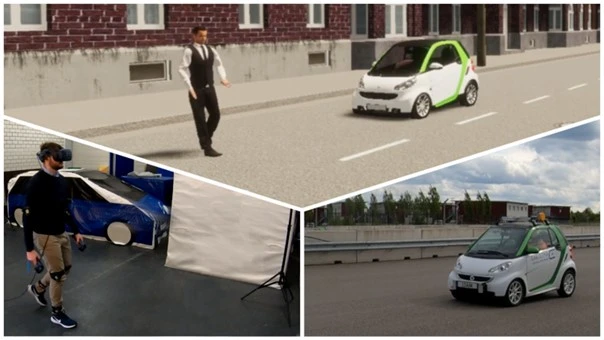
In the second sub-project, an architecture for networking real and virtual test components was further developed. To this end, an evaluation and comparison framework for driving scenarios was created, which compares the vehicle’s perception with simulation data (ground truth). This made it possible, in addition to a real test vehicle and pedestrian dummy, to control their virtual counterparts within a CARLA simulation environment, thereby enabling the implementation of mixed driving scenarios with varying degrees of realism. On this basis, different driving scenarios were carried out in real-world, purely virtual and mixed-reality (real-virtual) settings.
Result: The results show differences in driving behaviour between real and virtual tests, due to model simplifications. Whilst real and mixed scenarios exhibited a high degree of consistency in object detection, greater deviations occurred in purely virtual scenarios.
Contact

Prof. Dr.-Ing. Werner Huber
Phone: +49 841 9348-2523
Room: H020
E-Mail: Werner.Huber@thi.de

![[Translate to English:] Logo Akkreditierungsrat: Systemakkreditiert](/fileadmin/_processed_/2/8/csm_AR-Siegel_Systemakkreditierung_bc4ea3377d.webp)