
Impulse Project 8: Hybrid Models and AI Methods for Safe Mobility (HyMne) - Data Generation and Data Quality
Artificial intelligence (AI) is regarded as a promising method for bringing the complexity of autonomous mobility – caused by the infinite variety of possibilities and the underlying non-linear relationships – under control. Machine learning methods offer the possibility of capturing complex non-linear relationships in data and developing algorithms that are superior to conventional model-based approaches. However, AI methods face two major challenges. On the one hand, the use of such methods is limited by the available data volumes. On the other hand, the lack of interpretability, particularly with regard to safety systems, poses a major problem. This is precisely where the SAFIR IP8 project came in, with its hybrid models and the domain expertise of THI and its industry partners. Insufficient data volumes were partially compensated for by pre-processing steps based on expert knowledge. Similarly, machine learning methods were supplemented with expert knowledge in hybrid models to enable interpretability and to validate the outputs of the machine learning processes. It was precisely this combination of expert knowledge and AI that was important to the industry partners.
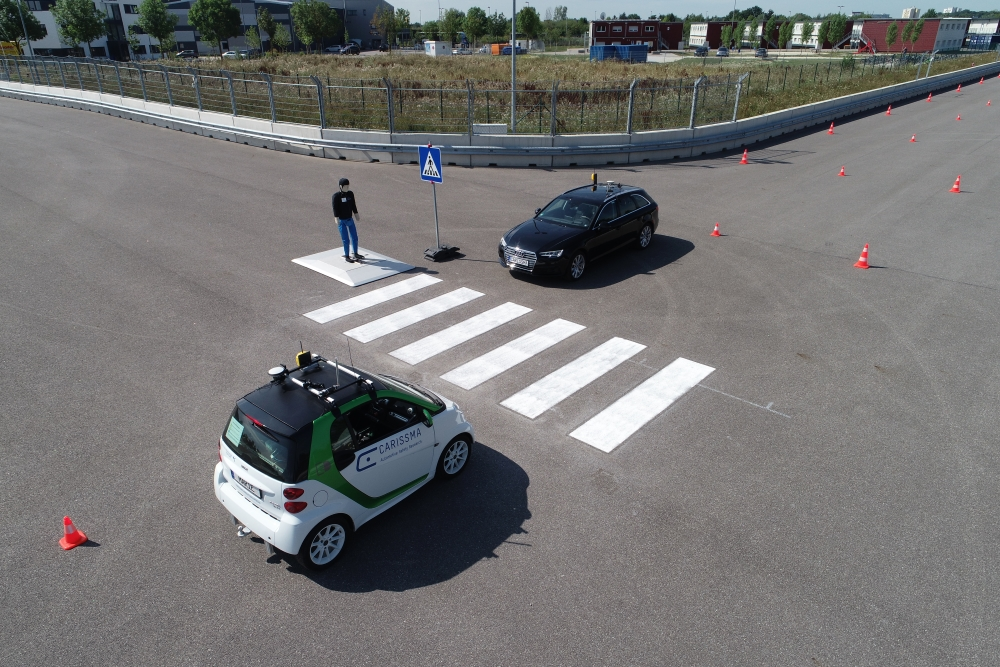
In addition to simulations, real-world driving tests are essential for testing systems that autonomously intervene in a vehicle’s longitudinal or lateral dynamics. Given the high costs of real-world testing, it is necessary to identify a small number of ‘relevant’, function-specific test scenarios, implement them in a reproducible manner within the vehicle, and subsequently evaluate them. Simulations can be used to identify and analyse these ‘relevant’ test scenarios, as can data from traffic scenarios recorded during journeys on public roads. During the intensification phase, bridges between the simulated and real worlds were established within the validation process with the aid of AI methods. The advantages of AI methods were utilised in a targeted manner.
In Sub-project I (High-precision state estimation and data generation), research was conducted into high-precision state estimation using inertial measurement systems in the absence of GPS signals or other external sources of correction data during real-world trials. The study investigated the extent to which on-board vehicle sensors are suitable for sensor fusion with the project partner’s inertial measurement system. In Sub-projects II (Driver Modelling for Function Development and Validation) and III (Testing Methodology for Automated Driving), real-world data was used to conduct research into adaptive driver modelling and the generation of urban traffic scenarios using AI methods.
Result: The combination of domain knowledge and machine learning is very helpful in generating highly accurate navigation correction data, producing realistic driver behaviour from data-based models, and generating test scenarios for the testing of automated driving functions. The HyMne2 project continues research in the field of hybrid AI methods, with the aim of demonstrating the benefits of these approaches in practical applications.
Contact

Prof. Dr.-Ing. Michael Botsch
Phone: +49 841 9348-2721
Room: K209
E-Mail: Michael.Botsch@thi.de
![[Translate to English:] Logo Akkreditierungsrat: Systemakkreditiert](/fileadmin/_processed_/2/8/csm_AR-Siegel_Systemakkreditierung_bc4ea3377d.webp)